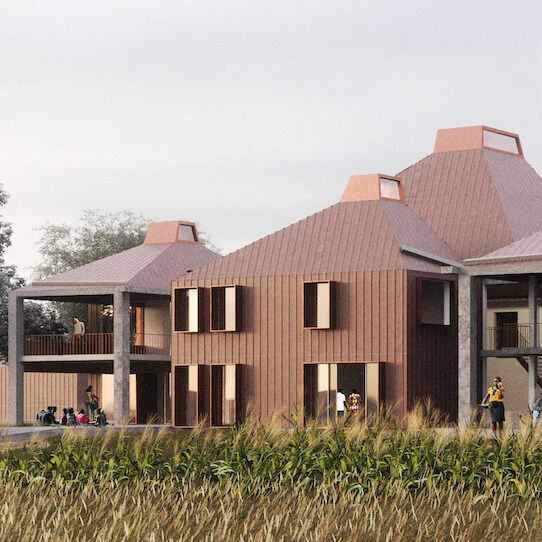
Center for Agricultural Transformation finalist of 2022 Architizer A+ Award
Award
Malawi's agricultural economy has long depended on tobacco. As public health pressures mount and market conditions shift, farmers need viable alternatives.
Located on Lilongwe's NRC campus, the Center for Agricultural Transformation (CAT) is well positioned to facilitate the transition away from this traditional crop. Here, farmers connect with researchers, students engage with demonstration technologies, and institutions pilot sustainable practices adapted to regional conditions.

The first challenge was to balance competing goals: institutional visibility; the flexibility to host research, teaching, and community outreach; and high-performance sustainability in a low-resource setting.
The Center needs to represent and reinforce its mission as a national hub for ag-tech innovation. At the same time, it has to remain welcoming, accessible and culturally relevant to a wide range of user groups, from farmers to academic researchers.

It was also essential to minimize reliance on mechanical systems in an environment where energy sources are not always reliable. The goal was to provide comfort through passive means while ensuring long-term maintainability, cost-efficiency and adaptability to local construction methods.
In short, the final design needed to reconcile performance with simplicity, presence with approachability, and innovation with adaptability to local building practices.


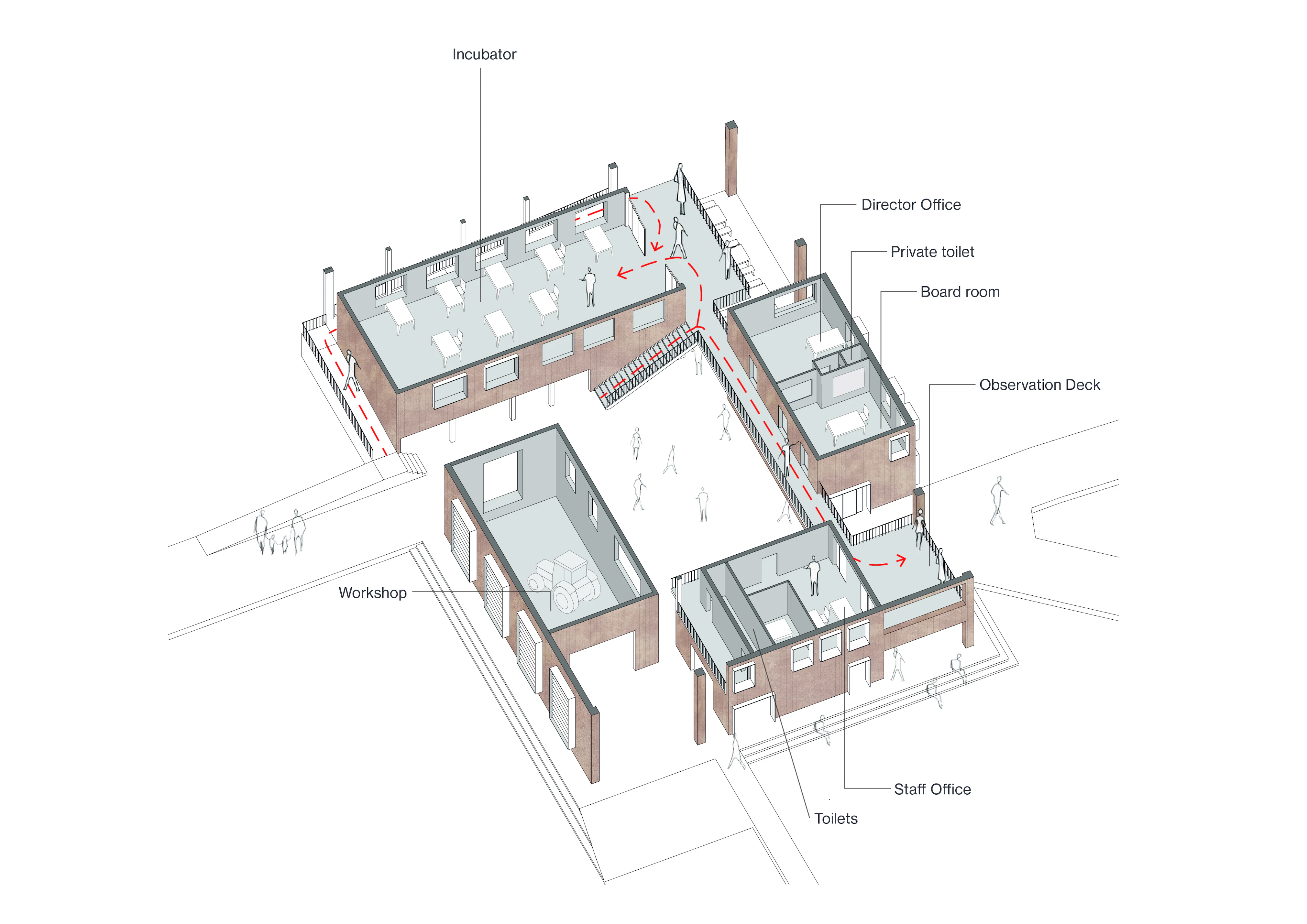
We organized four programmatic blocks around a central public space. This courtyard concept promotes spontaneous social interaction while regulating airflow and daylight.
The flexible, semi-open core facilitates gathering, teaching, and circulation between research labs, demonstration areas, and community spaces.

In collaboration with Transsolar, we integrated climate-responsive design with passive systems. Clerestory roofs, solar shading, and stack ventilation all help to minimize the need for air conditioning.

Roof-over clerestories enhance daylight quality while maximizing circulation, allowing warm air to escape from roof vents while allowing cooler air to enter from lower openings. PV arrays, meanwhile, provide energy resilience in the face of intermittent grid supply.
Material choices balanced performance with local constructability. Copper cladding wraps the five volumes, creating a monolithic appearance that will develop a brown patina over time. This natural material will age gracefully while providing a durability and sectional rhythm that grounds the building in its landscape.

The CAT building is characterized by its five copper-clad roofs, which echo the scattered mountains dotting Lilongwe valley. Yet these roofs do far more than mirror the landscape. Their profiles optimize daylight and ventilation while providing an instantly recognizable identity and high visibility.
Designed for passive cooling and largely free from complex technical infrastructure, the building minimizes long-term maintenance while adapting to the local climate and energy limitations.


The unified material palette and sectional rhythm create an iconic landmark that serves as a welcoming connector between the NRC campus and local agricultural communities.
Inside, the facility accommodates research laboratories, demonstration spaces, teaching areas, and community gathering zones. The courtyard functions as a connective space, allowing overlapping activities without rigid separation. Farmers accessing extension services share circulation with students attending lectures and researchers testing crop technologies.
As Malawi transitions away from tobacco-dependent farming, the Center is ready to foster knowledge exchange, demonstrate technology, and incubate agricultural innovation. It proves that high-performance sustainability can thrive in low-tech contexts, delivering climate comfort through architectural means rather than mechanical systems.